Unlocking Guide to Web Development | SEO | Digital Marketing

What is a subroutine in Java Programming? Java Tutorial 2024

What are subroutines in Java Programming?

In Java Programming, subroutines play a pivotal role in

  • Organizing code
  • Enhancing its readability
  • Promoting reusability
  • Subroutines are also Known commonly as methods or functions in other programming languages.
    Subroutines in Java Programming encapsulate a block of code that performs a specific task and can be invoked from multiple points within a program.
    This article delves into
    The fundamentals of subroutines in Java Programming,
  • The Syntax of Subroutines
  • Usage scenarios
  • And the benefits of using subroutines in Java Programming.

Syntax & Declaration of Subroutine in Java Programming

In Java Programming, a subroutine is declared within a class using the ‘method’ keyword followed by a return type (if applicable), a name, and parentheses containing optional parameters. Here’s a basic syntax breakdown:
Subroutines in Java Programming Umar Shakar

  • accessModifier: Specifies the visibility of the method (e.g., public, private, protected, or default).
  • returnType: Specifies the type of data the method returns after execution. If the method does not return a value, void is used.
  • methodName: The unique identifier for the method.
  • parameters: Optional input data that the method can accept.

Example Of a Simple Subroutine

Subroutines In Java Programming Language Umar Shakar

Example Of Subroutines In Java Programming Language

  • Add(int a, int b) is a method that takes two integers (a and b) as parameters and returns their sum.
  • PrintMessage(String message) is a method that takes a String parameter (message) and prints it to the console.

Benefits Of Using Subroutines In Java Programming Language:

  • Code Reusability: Once a method is defined, it can be called multiple times from different parts of the program, reducing redundancy and promoting maintainability.
  • Modularity: Breaking down tasks into smaller methods promotes a modular design, making the codebase easier to understand, test, and modify.
  • Abstraction: Methods provide an abstraction layer, allowing developers to focus on the functionality of each method without worrying about its implementation details.
  • Readability: Well-named methods improve the readability of code, making it easier for developers to grasp the purpose of each part of the program.
  • Scalability: Subroutines facilitate scalability by allowing new functionality to be added by simply defining new methods, rather than modifying existing code.

Types Of Methods In Java Programming Language:

In Java Programming, methods can be classified into several types based on their behavior and return type:

  • Void methods: Do not return a value (void).
  • Parameterized methods: Accept parameters to perform operations.
  • Static methods: Belong to the class rather than an instance of the class.
  • Return methods: Return a value of a specific type.

Subroutines are fundamental to structured programming in Java Programming, offering a way to encapsulate functionality, improve code organization, and enhance reusability. By understanding how to declare and utilize methods effectively, developers can create more maintainable, scalable, and readable Java Programming applications. Embracing the power of subroutines leads to modular code that is easier to debug, extend, and collaborate on, making it a cornerstone of modern software development practices.

Python Programming: Understanding Tuples

Python Programming : Introduction

In Python programming, tuples are a fundamental data structure used to store multiple values in a single variable. Tuples are similar to lists, but they are immutable, meaning their contents cannot be modified once created. In this article, we will explore the concept of tuples in Python, their syntax, and various operations that can be performed on them.

Python Programming: What are Tuples?

A tuple is a collection of values separated by commas and enclosed in parentheses. Tuples can contain any data type, including strings, integers, floats, and other tuples. Here is an example of a tuple:

my_tuple = (1, 2, 3, 4, 5)

Python Programming tuples umar shakar

Creating Tuples

Tuples can be created in several ways:

– Using the tuple() constructor:

my_tuple = tuple([1, 2, 3, 4, 5])

– Using the () operator:

my_tuple = (1, 2, 3, 4, 5)

– Using the * operator:

my_tuple = *(1, 2, 3, 4, 5)


Tuple Operations

Tuples support various operations, including:

– Indexing: Accessing elements of a tuple using their index.

my_tuple = (1, 2, 3, 4, 5)
print(my_tuple[0]) # Output: 1

Python Programming tuples umar shakar

– Slicing: Extracting a subset of elements from a tuple.

my_tuple = (1, 2, 3, 4, 5)
print(my_tuple[1:3]) # Output: (2, 3)


– Concatenation: Combining two or more tuples.

my_tuple1 = (1, 2, 3)
my_tuple2 = (4, 5, 6)
print(my_tuple1 + my_tuple2) # Output: (1, 2, 3, 4, 5, 6)

Conclusion

In conclusion, tuples are a powerful and flexible data structure in Python programming. They offer a convenient way to store and manipulate multiple values in a single variable. Understanding tuples is essential for any Python programmer, and this article has provided a comprehensive overview of their syntax, creation, and operations.

Mastering HTML Headings: A Comprehensive Tutorial

Introduction to HTML Headings

HTML headings play a pivotal role in web development by providing a clear and organized structure to web content. They not only enhance readability but also improve accessibility and search engine optimization (SEO). Headings help users quickly scan and understand the main topics and subtopics of a webpage, making the content more digestible and user-friendly.

There are six levels of HTML heading tags, ranging from <h1> to <h6>, each serving a unique purpose in the hierarchy of information. The <h1> tag is typically used for the main title or the most important heading on the page. It should be used sparingly, usually once per page, to signify the primary topic. Subsequent headings, from <h2> to <h6>, are used to denote subheadings and nested sections, creating a clear structure and logical flow.

Proper use of headings significantly boosts a website’s SEO. Search engines like Google use headings to understand the structure and context of the content, which can influence search rankings. By strategically incorporating keywords into headings, developers can make content more discoverable and relevant to search queries.

Accessibility is another crucial aspect of using HTML headings. Screen readers, used by visually impaired individuals, rely on headings to navigate through the content. Well-structured headings enable these users to jump directly to the sections they are interested in, enhancing their overall browsing experience.

In summary, mastering HTML headings is essential for anyone involved in web development. By understanding and utilizing the hierarchical significance of <h1> to <h6> tags, developers can create content that is not only visually organized but also optimized for both search engines and accessibility tools.

Understanding the Hierarchy of HTML Headings

HTML headings play a crucial role in structuring content on web pages. They range from <h1> to <h6>, with <h1> being the highest level and <h6> the lowest. This hierarchical arrangement helps both users and search engines understand the organization of the content.

The <h1> tag is typically used for the main title of a page. It should be unique and reflect the primary topic. For instance, in a blog post titled “Mastering HTML Headings,” the main heading would be:

<h1>Mastering HTML Headings</h1>

Subsequent headings, from <h2> to <h6>, are used for subheadings. These help to break down the content into manageable sections, making it easier for readers to follow. For example, sections within the main content can be introduced with <h2> headings:

<h2>Understanding the Hierarchy of HTML Headings</h2>

Within each of these sections, further subdivisions can be created using <h3> headings:

<h3>The Role of the <h1> Tag</h3>

As the hierarchy continues, <h4> to <h6> headings can be used for even more specific sub-sections:

<h4>Examples of Proper Nesting</h4>

Properly nesting these headings is essential for a well-structured document. An example of correct nesting might look like this:

<h1>Mastering HTML Headings</h1>

<h2>Understanding the Hierarchy of HTML Headings</h2>

<h3>The Role of the <h1> Tag</h3>

<h4>Examples of Proper Nesting</h4>

This hierarchical structure not only organizes the content but also enhances its readability and accessibility. By following this approach, you ensure that your document is both user-friendly and optimized for search engines, thereby improving the overall user experience.

Best Practices for Using HTML Headings

Proper use of HTML headings is crucial for structuring web content in a way that is both user-friendly and search engine optimized. One of the fundamental best practices is to avoid skipping heading levels. For instance, after using an <h1> tag for the main title, the next heading should be an <h2>, followed by an <h3>, and so on. Skipping levels can confuse both users and search engines, leading to a poor user experience and potentially lower search engine rankings.

Creating a logical flow with headings is another essential practice. Headings should act as signposts, guiding users through the content. This structure helps readers quickly find the information they seek, making the content more accessible and engaging. For example, a blog post might start with an <h1> for the main title, followed by <h2> tags for major sections, and <h3> tags for subsections within those sections. This hierarchy ensures that the content is easy to navigate.

Ensuring that headings are descriptive and relevant is also important. A heading should give a clear indication of the content that follows. Vague or overly generic headings can frustrate users and diminish the content’s SEO value. For instance, a heading like “Best Practices for Using HTML Headings” is more informative than simply “Best Practices.”

Common mistakes include using headings purely for styling purposes, rather than for structuring content. This often leads to the misuse of lower-level headings for aesthetic reasons, which can disrupt the logical flow and confuse screen readers. To avoid this, use CSS for styling and reserve HTML headings for their intended purpose: organizing content.

By adhering to these best practices—avoiding skipped levels, creating a logical flow, and ensuring descriptive and relevant headings—you can significantly enhance both the usability and SEO performance of your web content. Proper use of HTML headings not only benefits end-users but also aligns with search engine algorithms, improving the overall effectiveness of your content.

SEO Benefits of Proper HTML Headings

Proper use of HTML headings, such as <h1> to <h6>, offers significant SEO benefits by enhancing both content structure and search engine understanding. Search engines, like Google, utilize these headings to decipher the hierarchy and context of web content, thereby influencing indexing and ranking processes. When HTML headings are well-structured, they provide a clear roadmap of the content, making it easier for search engines to ascertain the main themes and topics covered on a page.

For instance, the <h1> tag, which is typically reserved for the main title, should succinctly encapsulate the primary focus of the page. Subsequent headings, such as <h2> and <h3>, should logically break down the content into subtopics, each addressing different but related aspects of the main topic. This hierarchical structure not only aids search engines in understanding the content but also enhances user experience by making the content more navigable and digestible.

Optimizing headings for keywords is another crucial aspect of leveraging HTML headings for SEO. It is advisable to incorporate relevant keywords naturally within headings, ensuring they align with the content’s intent without resorting to keyword stuffing. Overuse of keywords can lead to penalties from search engines, diminishing the SEO value. Instead, aim for a balanced approach where keywords are seamlessly integrated, reflecting the genuine context of the content.

Moreover, well-optimized headings can significantly enhance page ranking. Search engines prioritize content that is well-organized and easy to understand, often rewarding such pages with higher visibility in search results. Additionally, headings can improve click-through rates in search engine results by providing clear, compelling summaries of the content, thus attracting more traffic.

In essence, proper HTML headings are a vital component of on-page SEO strategy. They not only facilitate better search engine comprehension and indexing but also contribute to an improved user experience, ultimately leading to higher page rankings and increased visibility.

Accessibility Considerations for HTML Headings

Accessibility is a cornerstone of effective web design, and HTML headings play a pivotal role in ensuring content is navigable for users of all abilities. For individuals using screen readers, headings serve as crucial navigational landmarks. Screen readers interpret headings to provide an outline of the page’s structure, enabling users to quickly understand and jump to the sections that interest them. This functionality is especially vital for users with visual impairments, as it offers an efficient way to explore content without needing to read through everything sequentially.

To make headings accessible, it is essential to follow certain best practices. One key guideline is to use the appropriate ARIA (Accessible Rich Internet Applications) roles. ARIA roles can help define the structural outline of a document, ensuring that screen readers correctly interpret the hierarchy. For example, using the role="heading" attribute along with the aria-level attribute can explicitly convey the level of a heading, which is particularly useful for dynamic content where heading levels may not be explicitly defined by standard HTML tags.

Maintaining a logical heading order is another crucial aspect. Headings should ideally follow a hierarchical structure from <h1> to <h6> without skipping levels. For instance, an <h2> should be followed by either another <h2> or an <h3>, but not an <h4> directly. This logical sequence helps screen readers accurately map the document structure, thereby enhancing the user experience for individuals relying on assistive technologies.

Additionally, each page should have a single <h1> element that conveys the main topic or purpose of the page. Subsections can then be marked with subsequent heading levels to create a clear, navigable structure. Employing these practices not only improves accessibility but also enhances overall content organization, benefiting all users.

Styling HTML Headings with CSS

Styling HTML headings with CSS is a fundamental skill for web developers aiming to enhance the visual appeal and usability of their web pages. By applying CSS to HTML headings, you can control various styling properties such as font size, color, and margin, as well as implement advanced techniques like responsive design, custom fonts, and text effects.

To start with basic styling, you can adjust the font size and color of your headings using simple CSS properties. For instance:

h1 {
font-size: 2em;
color: #333;
}
h2 {
font-size: 1.5em;
color: #666;
}

In the above example, the font-size property is used to set the size of the text, while the color property defines the color. You can further enhance the layout by adjusting margins:

h1 {
margin-bottom: 20px;
}
h2 {
margin-top: 10px;
}

For more advanced styling, custom fonts can dramatically change the look and feel of your headings. Using the @font-face rule, you can import fonts from external sources:

@font-face {
font-family: 'CustomFont';
src: url('customfont.woff2') format('woff2');
}
h1 {
font-family: 'CustomFont', sans-serif;
}

Responsive design ensures that your headings look great on all devices. Use media queries to adjust font sizes dynamically:

@media (max-width: 600px) {
h1 {
font-size: 1.5em;
}
h2 {
font-size: 1.2em;
}
}

Text effects can add an extra layer of sophistication to your headings. For example, you can use the text-shadow property:

h1 {
text-shadow: 2px 2px 5px rgba(0, 0, 0, 0.3);
}

By mastering these CSS techniques, you can create visually appealing and functional HTML headings that significantly enhance user experience on your website.

Common Use Cases and Examples

HTML headings play a pivotal role in structuring content across various types of websites, ensuring clarity and ease of navigation for users. By examining real-world examples, we can better understand how to effectively utilize headings to enhance user experience.

In blogs, headings are crucial for breaking down lengthy articles into manageable sections. A typical blog post may start with an <h1> tag for the main title, followed by <h2> tags for major subheadings, and <h3> tags for more detailed sub-sections. For instance:

<h1>The Ultimate Guide to Gardening</h1><h2>Introduction</h2><h2>Tools You Need</h2><h3>Basic Tools</h3><h3>Advanced Tools</h3><h2>Planting Techniques</h2><h3>Seed Starting</h3><h3>Transplanting</h3>

This hierarchy not only aids in SEO but also allows readers to quickly skim through the content to find sections of interest.

For e-commerce websites, headings help in organizing products and categories, making it easier for customers to navigate. A product page might use an <h1> tag for the product name, <h2> tags for sections like “Description” and “Reviews,” and <h3> tags for detailed subsections within those categories:

<h1>Organic Cotton T-Shirt</h1><h2>Product Description</h2><h3>Material and Care</h3><h3>Size Guide</h3><h2>Customer Reviews</h2><h3>Top Reviews</h3><h3>Recent Reviews</h3>

In portfolios, headings are used to display an individual’s work and accomplishments clearly. An <h1> tag might be used for the portfolio owner’s name, <h2> tags for different sections such as “Projects” and “Experience,” and <h3> tags for specific projects or job roles:

<h1>Jane Doe</h1><h2>Projects</h2><h3>Web Development Portfolio</h3><h3>Graphic Design Showcase</h3><h2>Professional Experience</h2><h3>Senior Developer</h3><h3>Graphic Designer</h3>

By utilizing a structured heading approach, websites can significantly improve their usability, making it easier for visitors to find the information they need quickly and efficiently.

Conclusion and Additional Resources

Throughout this comprehensive tutorial, we have delved into the essential aspects of mastering HTML headings. We began by understanding the importance of headings in structuring web content, progressing through the hierarchy from <h1> to <h6>. We also explored best practices for using these tags effectively, emphasizing their role in enhancing readability and SEO. Additionally, we examined how to style headings with CSS to create visually appealing web pages.

As you continue to develop your web projects, it is crucial to practice and experiment with HTML headings. Doing so will not only refine your skills but also contribute to creating more organized and user-friendly websites. Remember, the proper use of headings can significantly impact user experience and search engine rankings.

For those seeking to deepen their knowledge, there are numerous resources available. The MDN Web Docs provide detailed documentation on HTML heading elements. Additionally, platforms like Coursera and Udemy offer online courses that cover HTML, CSS, and web development comprehensively. Tools such as CodePen allow you to experiment with code in real-time, offering a practical way to apply what you’ve learned.

We encourage you to share your feedback or ask questions in the comments section below. Your insights and inquiries will help us improve and provide more value to our readers. Engage with the community and continue your learning journey by exploring the additional resources provided. Mastering HTML headings is just the beginning of creating exceptional web content.

View Our Blog Page to Learn More

Understanding the Differences Between Lists and Dictionaries in Python

Introduction to Python’s Data Structures

Python, a versatile and powerful programming language, offers a variety of data structures to help developers efficiently manage and manipulate data. Among these, lists and dictionaries are two of the most fundamental and commonly used data structures. Understanding these structures is crucial for anyone looking to delve into Python programming, as they form the backbone of data organization and retrieval in the language.

Lists in Python are ordered collections of items that can be of any data type. This flexibility allows lists to be used in a myriad of scenarios, such as storing sequences of numbers, strings, or even other lists. One of the key features of lists is their ability to maintain the order of elements, making them ideal for tasks that require sequence preservation and indexed access. For instance, lists are commonly used in scenarios where you need to iterate over a collection of items or maintain a specific order of processing.

On the other hand, dictionaries are unordered collections of key-value pairs. Each key in a dictionary is unique, and it maps to a specific value, providing an efficient way to store and retrieve data based on a unique identifier. This characteristic makes dictionaries particularly useful for tasks that involve fast lookups, such as implementing lookup tables, counting occurrences, or managing datasets with unique keys. Unlike lists, the order of elements in a dictionary is not guaranteed, which is a trade-off for the efficiency gained in data retrieval.

Both lists and dictionaries play a pivotal role in data organization and retrieval efficiency in Python. Lists are optimized for scenarios requiring ordered data and indexed access, while dictionaries provide a robust solution for fast and efficient key-based lookups. By leveraging these data structures appropriately, developers can write more efficient and effective Python code, tailored to the specific needs of their applications.

What is a List in Python?

In Python, a list is a collection data type that is ordered and mutable, meaning that the elements within a list can be changed after the list has been created. Lists are defined by placing a comma-separated sequence of elements within square brackets []. They can contain elements of different data types, including integers, strings, and even other lists.

To create a list in Python, you simply assign a sequence of elements to a variable using square brackets. For example:

my_list = [1, 2, 3, 'four', 5.0]

One of the fundamental features of lists is their ability to be indexed and sliced. Indexing allows you to access individual elements within the list by their position, starting from zero. For example:

first_element = my_list[0] # Outputs 1

Slicing, on the other hand, allows you to access a range of elements within the list. This is done by specifying a start and end index. For example:

sub_list = my_list[1:4] # Outputs [2, 3, 'four']

Python lists also come with a variety of built-in methods that make them highly versatile. Some common list methods include:

  • append(item): Adds an item to the end of the list.
  • remove(item): Removes the first occurrence of the specified item from the list.
  • sort(): Sorts the list in ascending order by default.

For example:

my_list.append(6) # my_list becomes [1, 2, 3, 'four', 5.0, 6]

my_list.remove('four') # my_list becomes [1, 2, 3, 5.0, 6]

my_list.sort() # This will raise an error if the list contains both numbers and strings

In summary, lists in Python are a powerful and flexible data structure that allows for dynamic data storage and manipulation. Their ability to handle multiple data types, along with a robust set of methods, makes them an essential tool for any Python programmer.

What is a Dictionary in Python?

A dictionary in Python is a mutable, unordered collection of items. Unlike lists, which are indexed by a range of numbers, dictionaries are indexed by keys. Each key-value pair in a dictionary maps the key to its associated value. This key-value structure allows for efficient data retrieval, making dictionaries extremely useful for various applications.

Creating a dictionary in Python is straightforward. You can define a dictionary by enclosing a comma-separated list of key-value pairs within curly braces `{}`. Each key-value pair is separated by a colon `:`. Here’s an example:

my_dict = {'name': 'Alice', 'age': 25, 'city': 'New York'}

In this example, `my_dict` is a dictionary with three key-value pairs. The keys are `’name’`, `’age’`, and `’city’`, while the values are `’Alice’`, `25`, and `’New York’`, respectively. To access a value, you use the corresponding key in square brackets:

age = my_dict['age'] # Output: 25

Python dictionaries also come with several built-in methods that facilitate various operations. For instance, you can retrieve a list of all keys using the `keys()` method, all values using the `values()` method, and all key-value pairs using the `items()` method:

keys = my_dict.keys() # Output: dict_keys(['name', 'age', 'city'])

values = my_dict.values() # Output: dict_values(['Alice', 25, 'New York'])

items = my_dict.items() # Output: dict_items([('name', 'Alice'), ('age', 25), ('city', 'New York')])

Moreover, dictionaries are mutable, meaning you can add, modify, or remove key-value pairs. To add or update a key-value pair, you simply assign a value to a key:

my_dict['email'] = 'alice@example.com' # Adds a new key-value pair

my_dict['age'] = 26 # Updates the value of the existing key 'age'

To remove a key-value pair, you can use the `del` statement:

del my_dict['city'] # Removes the key-value pair with key 'city'

Understanding how to effectively utilize dictionaries in Python can significantly enhance the efficiency and readability of your code, particularly when dealing with complex data structures and lookup operations.

Key Differences Between Lists and Dictionaries

Understanding the key differences between lists and dictionaries in Python is essential for effective programming. One of the primary distinctions lies in how data is stored and accessed. Lists are ordered collections of items where each element is indexed by a position. This means that you can access elements using their numerical index, starting from zero. For example, if you have a list my_list = [10, 20, 30], the element at index 1 is 20.

Conversely, dictionaries are unordered collections that store data in key-value pairs. Each value is associated with a unique key, and you access the values using these keys rather than indexes. For instance, given a dictionary my_dict = {'a': 1, 'b': 2, 'c': 3}, you can retrieve the value associated with key ‘b’ by referencing my_dict['b'], which would return 2.

Another significant difference between lists and dictionaries is their typical use cases. Lists are ideal for maintaining ordered sequences of items, making them suitable for scenarios where the order of elements matters, such as storing a series of numbers, names, or other sequential data. In contrast, dictionaries are best used for scenarios where data needs to be quickly retrieved or manipulated based on a unique key, such as storing and accessing configuration settings, user data, or any other keyed information.

Performance and efficiency are also impacted by these structural differences. Accessing elements in a list is generally faster when the index is known, as it operates in constant time, O(1). However, inserting or deleting elements can be costly, particularly for large lists, as it may require shifting elements. On the other hand, dictionaries are optimized for fast lookups, insertions, and deletions using keys, typically operating in average-case constant time, O(1), due to their underlying hash table implementation. However, the performance can degrade if there are many collisions in the hash table.

In summary, the choice between using a list or a dictionary in Python depends heavily on the nature of the data and the specific requirements of the task at hand. Understanding these fundamental differences enables developers to make more informed decisions, optimizing both code readability and performance.

Use Cases for Lists

When working with Python, it’s essential to understand when to utilize lists as the preferred data structure. Lists are particularly advantageous in scenarios where managing ordered collections is critical. For instance, consider a situation where you need to maintain a sequence of elements, such as daily temperature readings or a list of tasks to complete. Because lists inherently preserve the order in which elements are added, they are ideal for such applications.

Another significant use case for lists is when performing iterative operations. Given that lists are iterable, they can be efficiently used in loops to execute repetitive tasks. For example, if you need to apply a specific calculation to each element in a collection, a list allows you to easily iterate through its elements using a for loop:

temperatures = [72, 68, 65, 75, 70]
adjusted_temperatures = [temp - 2 for temp in temperatures]
print(adjusted_temperatures) # Output: [70, 66, 63, 73, 68]

Index-based access is another compelling reason to choose lists. Lists provide constant time complexity, O(1), for accessing elements by their index. This makes lists highly efficient for scenarios where you need to frequently retrieve or modify elements at specific positions. For example, consider a situation where you are managing a list of student grades, and you need to update the grade for a particular student:

grades = [88, 92, 79, 93, 85]
grades[2] = 82
print(grades) # Output: [88, 92, 82, 93, 85]

In real-world applications, lists are also commonly used for tasks such as storing and manipulating collections of data in web development, managing sequences in data analysis, and organizing elements in graphical user interfaces. Their flexibility and efficiency in handling ordered data make them an indispensable tool in any Python programmer’s toolkit.

Use Cases for Dictionaries

Dictionaries in Python are highly efficient for scenarios requiring fast lookups, association of unique keys with corresponding values, and handling data with a non-linear structure. These attributes make dictionaries particularly suitable for applications where quick access to data is crucial and where each piece of data is uniquely identified by a key.

One common use case for dictionaries is in implementing databases or caches. For instance, when you need to store user information where each user has a unique identifier, dictionaries provide an optimal solution. The key-value pairing allows for rapid retrieval and updating of user data. Consider the following example:

user_data = {    'user_001': {'name': 'Alice', 'age': 28, 'email': 'alice@example.com'},    'user_002': {'name': 'Bob', 'age': 34, 'email': 'bob@example.com'}}# Accessing dataprint(user_data['user_001']['name'])  # Output: Alice

Another scenario where dictionaries excel is in counting occurrences of items. In text analysis, for example, dictionaries can be used to count word frequencies in a document. This approach leverages the fast lookup time of dictionaries, making it more efficient than lists for such a purpose:

text = "apple banana apple orange banana apple"word_count = {}for word in text.split():    if word in word_count:        word_count[word] += 1    else:        word_count[word] = 1print(word_count)  # Output: {'apple': 3, 'banana': 2, 'orange': 1}

Dictionaries are also ideal for managing configurations or settings in software applications. They allow for easy modification and retrieval of configuration parameters by their names. For example:

config = {    'theme': 'dark',    'language': 'en',    'timeout': 30}# Changing a configurationconfig['timeout'] = 60print(config['timeout'])  # Output: 60

In summary, dictionaries are indispensable in various real-world applications due to their ability to handle fast lookups, unique key-value associations, and non-linear data structures efficiently. Whether managing user data, counting word frequencies, or handling configuration settings, dictionaries offer a robust and flexible approach to data management in Python.

Performance Considerations

When choosing between lists and dictionaries in Python, understanding their performance implications is crucial. Both data structures have distinct time complexities for common operations such as lookup, insertion, and deletion, which can significantly impact the efficiency of a program.

For lookup operations, dictionaries are generally more efficient than lists. The average time complexity for a dictionary lookup is O(1), thanks to its underlying hash table implementation. This means that accessing a value based on its key is done in constant time. Conversely, lists have a lookup time complexity of O(n), where n is the number of elements in the list. This is because, in the worst-case scenario, the entire list may need to be traversed to find the desired element.

Insertion operations also differ between lists and dictionaries. Adding an element to a dictionary has an average time complexity of O(1), while inserting an element into a list can have a time complexity of O(n) if the element needs to be inserted at a specific position other than the end. If the insertion is at the end of the list, the time complexity is O(1), similar to a dictionary.

Deletion operations follow a similar pattern. Removing an element from a dictionary averages O(1) time complexity, as it involves locating the key and removing the associated entry. In contrast, deleting an element from a list has a time complexity of O(n) because the list may need to be re-indexed after the deletion.

Memory usage is another important consideration. Dictionaries typically consume more memory than lists due to their hash table implementation, which requires additional space for storing keys and values. Lists, being simpler in structure, are often more memory-efficient, especially when dealing with large collections of data.

In benchmarks and real-world applications, the choice between lists and dictionaries can significantly affect performance. For instance, if frequent lookups and dynamic inserts or deletions are required, dictionaries may offer better performance. On the other hand, if memory usage is a critical factor and the data set is relatively small or requires ordered access, lists might be the more suitable choice.

Conclusion

In summary, understanding the differences between lists and dictionaries in Python is crucial for effective programming and optimal performance. Lists and dictionaries are both essential data structures, but they serve different purposes and have distinct characteristics.

Lists are ordered collections that allow duplicate elements and are indexed by integers. They are ideal for maintaining sequences of items where order matters, such as to-do lists, queues, or any scenario where you need to iterate over elements in a specific sequence. Lists provide efficient access by index, making them suitable for operations that involve frequent indexing and slicing.

On the other hand, dictionaries are unordered collections that store data as key-value pairs, where keys are unique. They are highly efficient for lookups, updates, and deletions based on keys. Dictionaries excel in scenarios where fast access to data via unique keys is required, such as maintaining a phone directory, counting occurrences of elements, or implementing associative arrays.

From a performance perspective, lists have an average time complexity of O(1) for appending elements and O(n) for searching or deleting elements. Dictionaries, with their underlying hash table implementation, provide average time complexities of O(1) for lookups, insertions, and deletions, making them superior in scenarios requiring quick access.

Choosing between lists and dictionaries ultimately depends on the specific needs of your program. If you need to preserve order and handle sequences of elements efficiently, lists are the way to go. However, if your use case involves fast lookups, associations, or unique key-value pairs, dictionaries are the better choice.

By leveraging the strengths of both lists and dictionaries, you can write more efficient and readable Python code that is tailored to the unique requirements of your projects.

View Our Blog TO Learn More

An In-Depth Introduction to Python: A Beginner’s Guide

Introduction To Python

introduction to python umar shakar

Python is a high-level, interpreted programming language created by Guido van Rossum and first released in 1991. Designed with an emphasis on code readability, Python aims to help programmers write clear and logical code for both small and large-scale projects. The language’s simple syntax, which mimics natural language, makes it particularly accessible to beginners while still being powerful enough for experienced developers.

One of Python’s core strengths is its versatility. It is widely used across an array of domains, including web development, data science, artificial intelligence, machine learning, and automation. This broad applicability is facilitated by a vast ecosystem of libraries and frameworks, such as Django and Flask for web development, Pandas and NumPy for data manipulation, and TensorFlow and PyTorch for machine learning.

Python’s creation was driven by Guido van Rossum’s desire to address the shortcomings of the ABC language, which he had worked on in the 1980s. He aimed to create a language that was as powerful as ABC but more open and extensible. Python’s first public release was version 0.9.0, which included many of the features that are still present today, such as exception handling, functions, and modules.

The language’s popularity has surged over the past decades, largely due to its readability and the strong community support. Python consistently ranks among the top programming languages in various indexes, including the TIOBE Index and the PYPL Popularity of Programming Language index. Its growing influence is evidenced by its adoption by major corporations like Google, Facebook, and Netflix, which use Python for a myriad of applications ranging from backend services to data analysis.

Overall, Python’s combination of simplicity, readability, and versatility makes it an excellent choice for both novice and seasoned developers, positioning it as a cornerstone in the programming world.

Why Learn Python?

Python has become one of the most popular programming languages in the world, and for good reasons. Its versatility makes it a valuable skill for developers, data scientists, and analysts alike. One of the main attractions of Python is its application across various fields. Whether you are interested in web development, data analysis, artificial intelligence, scientific computing, or automation, Python has tools and libraries to support your endeavors.

The high demand for Python programmers in the job market is another compelling reason to learn this language. Companies ranging from innovative startups to large, established corporations are seeking professionals with Python expertise. This demand translates into numerous job opportunities, competitive salaries, and enhanced career growth. Python’s easy-to-read syntax and dynamic typing also make it an ideal language for beginners who are just getting started in programming.

Beyond its versatility and demand, Python offers extensive community support. A large and active community means a wealth of resources, including tutorials, forums, and documentation, which can be invaluable for both beginners and experienced developers. The support from this community ensures that you are not alone in your learning journey, providing guidance and solutions to common challenges.

Python’s extensive libraries and frameworks are another significant advantage. These tools simplify complex tasks, allowing developers to focus on solving problems rather than getting bogged down by intricate coding details. For instance, libraries like Pandas and NumPy facilitate data analysis, while frameworks like Django and Flask streamline web development. Machine learning enthusiasts benefit from libraries like TensorFlow and Scikit-learn, which offer powerful tools for building sophisticated models.

In conclusion, learning Python is a strategic decision that opens up numerous opportunities across various industries. Its versatility, high demand, community support, and extensive libraries make it a preferred language for both beginners and seasoned professionals.

Setting Up Python

Setting up Python on your system is the first step in beginning your programming journey. The installation process varies slightly depending on the operating system you are using. Below, we provide a detailed guide to installing Python on Windows, macOS, and Linux, ensuring that you have a seamless experience.

Installing Python on Windows

1. Visit the official Python website at python.org.

2. Navigate to the Downloads section and select ‘Python 3.x.x’ for Windows.

3. Download the installer and run it. Ensure you check the box that says “Add Python to PATH” before clicking ‘Install Now’.

4. Once the installation is complete, open Command Prompt and type python to verify the installation.

Installing Python on macOS

1. Go to the official Python website at python.org.

2. In the Downloads section, select ‘Python 3.x.x’ for macOS.

3. Download the macOS installer and follow the on-screen instructions to complete the installation.

4. Open Terminal and type python3 to verify the installation.

Installing Python on Linux

1. Open Terminal.

2. Update your package list by running sudo apt update.

3. Install Python using the command sudo apt install python3.

4. Verify the installation by typing python3 --version.

Setting Up a Virtual Environment

Setting up a virtual environment is crucial for managing project dependencies and avoiding conflicts between different projects. To create a virtual environment, follow these steps:

1. Open your terminal or command prompt.

2. Install the virtual environment package by running pip install virtualenv.

3. Navigate to your project directory and create a virtual environment using virtualenv venv.

4. Activate the virtual environment:

  • On Windows: venv\Scripts\activate
  • On macOS and Linux: source venv/bin/activate


Once activated, you can install project-specific dependencies without affecting your global Python installation. Deactivate the virtual environment anytime by typing deactivate.

Python Syntax and Basics

Python, known for its simplicity and readability, is an excellent choice for beginners. Its syntax is straightforward, making it easy to learn and use. At the core of Python’s syntax are variables, data types, and basic operations.

Variables in Python are used to store data. Unlike many other programming languages, Python does not require explicit declaration of variables. You can simply assign a value to a variable using the equals sign (`=`). For instance:

name = "Alice"
age = 25
height = 5.6

Python supports various data types, including strings, integers, floats, and lists. Strings are sequences of characters, integers represent whole numbers, floats are used for decimal numbers, and lists are ordered collections of items. Here are examples of each:

# String
greeting = "Hello, World!"

# Integer
year = 2023

# Float
pi = 3.14159

# List
fruits = [“apple”, “banana”, “cherry”]

Arithmetic operations in Python are intuitive. You can perform addition (`+`), subtraction (`-`), multiplication (`*`), and division (`/`) directly on numbers:

a = 10
b = 5

sum = a + b
difference = a – b
product = a * b
quotient = a / b

One of the distinguishing features of Python is its use of indentation to define the structure of the code. Unlike other programming languages that use braces or keywords, Python relies on indentation levels to indicate blocks of code. This enhances readability but requires careful attention to spacing. For example:

if age > 18:
print("You are an adult.")
else:
print("You are a minor.")

Notice how the `if` statement and `else` block are aligned, and the statements within each block are indented. This is crucial for ensuring that the code runs correctly.

Below is a simple Python code snippet that demonstrates these concepts:

name = "Alice"
age = 25
if age >= 18:
print(f"{name} is an adult.")
else:
print(f"{name} is a minor.")

“`html

Control Flow in Python

Control flow statements in Python allow developers to dictate the sequence in which code executes, enabling more complex and dynamic behaviors in programs. Among the most fundamental control flow mechanisms are the if-else statements, for loops, and while loops.

The if-else statement is the cornerstone of decision-making in Python. Its syntax is straightforward:

if condition:

    # code to execute if condition is true

else:

    # code to execute if condition is false

For example:

age = 18

if age >= 18:

    print("You are an adult.")

else:

    print("You are a minor.")

Next, for loops are used for iterating over sequences such as lists, tuples, or strings. The basic syntax is:

for item in sequence:

    # code to execute for each item

Consider this example:

for number in range(5):

    print(number)

This code will print numbers from 0 to 4. The range() function generates a sequence of numbers, making it a common companion to for loops.

While loops, on the other hand, continue executing as long as a specified condition remains true. Their syntax is:

while condition:

    # code to execute while condition is true

Example:

count = 0

while count < 5:

    print(count)

    count += 1

This loop will print numbers from 0 to 4, incrementing count in each iteration.

Common pitfalls include forgetting to update the condition in while loops, leading to infinite loops, and improper indentation, which can cause syntax errors. Best practices involve clear and consistent code formatting, using breakpoints to exit loops early when necessary, and ensuring conditions will eventually become false to avoid infinite loops.

Below is an illustrative diagram of control flow:


Understanding and correctly implementing control flow statements is crucial for writing efficient and effective Python programs. By mastering these constructs, programmers can significantly enhance the logic and functionality of their code.

“`

Functions and Modules

Functions are fundamental building blocks in Python programming, enabling developers to encapsulate reusable blocks of code and streamline processes. A function is defined using the def keyword, followed by the function name and parentheses containing any parameters. For example:

def greet(name):
return f"Hello, {name}!"

In this example, greet is a function that takes a single parameter name and returns a greeting string. Functions are called by using their name followed by parentheses containing any arguments:

message = greet("Alice")
print(message)

This will output: Hello, Alice!. Functions are crucial for structuring code, promoting modularity, and reducing redundancy. By breaking down complex tasks into smaller, manageable functions, code becomes more readable and maintainable.

Modules in Python are files containing Python code—such as functions and classes—that can be imported and used in other Python scripts. This allows for greater code organization and reusability. To create a module, simply save Python code in a file with a .py extension. For instance, consider a module named math_utils.py:

def add(a, b):
return a + b

To use this module in another script, employ the import statement:

import math_utils
result = math_utils.add(3, 5)
print(result)

This will output: 8. It’s also possible to import specific functions from a module:

from math_utils import add
result = add(3, 5)
print(result)

Using functions and modules effectively is essential for efficient Python programming. By organizing code into distinct, reusable sections, developers can enhance their productivity and maintainability of their projects.

Working with Data

Handling data efficiently is a cornerstone of programming in Python. The language offers versatile and powerful data structures such as lists, dictionaries, and tuples, each with unique properties and use cases. Let’s delve into these fundamental data types and explore some common operations.

Lists are mutable sequences, meaning their elements can be changed. You can add elements using the append() or extend() methods, remove them with remove() or pop(), and access elements via indexing. For instance:

# Creating a list
fruits = ['apple', 'banana', 'cherry']
# Adding an element
fruits.append('date')
# Removing an element
fruits.remove('banana')
# Accessing an element
print(fruits[1]) # Output: cherry

Dictionaries are mutable mappings of unique keys to values. They are highly efficient for lookups, adding, and removing key-value pairs. For example:

# Creating a dictionary
student = {'name': 'John', 'age': 25, 'courses': ['Math', 'Science']}
# Adding a key-value pair
student['grade'] = 'A'
# Removing a key-value pair
del student['age']
# Accessing a value
print(student['name']) # Output: John

Tuples are immutable sequences, meaning once created, their elements cannot be changed. They are useful for fixed collections of items. For example:

# Creating a tuple
coordinates = (10.0, 20.0)
# Accessing an element
print(coordinates[0]) # Output: 10.0

Beyond these basic structures, Python also supports file operations. Reading from and writing to files is straightforward:

# Writing to a file
with open('example.txt', 'w') as file:
file.write('Hello, World!')
# Reading from a file
with open('example.txt', 'r') as file:
content = file.read()
print(content) # Output: Hello, World!

For more advanced data manipulation, libraries such as Pandas offer robust tools. Pandas facilitates data analysis and manipulation with powerful DataFrame objects. Here’s a simple use case:

import pandas as pd
# Creating a DataFrame
data = {'Name': ['Anna', 'Bob'], 'Age': [28, 24]}
df = pd.DataFrame(data)
print(df)

Data handling in Python is both intuitive and powerful, making it an ideal choice for beginners and professionals alike.

Next Steps and Resources

After mastering the basics of Python, the journey to becoming proficient in this versatile programming language is just beginning. There are numerous advanced topics and specialized areas you can explore to expand your Python skills and apply them to various domains. One of the logical next steps is to delve into Object-Oriented Programming (OOP). Understanding OOP concepts such as classes, objects, inheritance, and polymorphism will enable you to write more efficient and reusable code.

For those interested in web development, learning frameworks like Django or Flask can be incredibly beneficial. Django is a high-level web framework that encourages rapid development and clean, pragmatic design. Flask, on the other hand, is a micro-framework that provides the essentials to get a web application running, allowing for more flexibility in the design. Both frameworks have extensive documentation and a strong community, making them excellent choices for web development projects.

Data science is another compelling area where Python shines. Libraries like NumPy and Pandas are essential for data manipulation and analysis. NumPy provides support for large multi-dimensional arrays and matrices, along with a collection of mathematical functions to operate on these arrays. Pandas offer data structures and functions designed to make data analysis fast and easy. For more advanced data science tasks, you can explore libraries like SciPy for scientific computing and Matplotlib or Seaborn for data visualization.

To further your learning, there are numerous resources available online. Websites like Coursera, edX, and Udacity offer courses ranging from beginner to advanced levels. Books such as “Automate the Boring Stuff with Python” by Al Sweigart and “Python Crash Course” by Eric Matthes are highly recommended for practical learning. Additionally, joining Python communities on platforms like GitHub, Stack Overflow, or Reddit can provide valuable insights and collaborative opportunities.

With a plethora of resources and advanced topics to explore, the journey with Python can be both rewarding and endless. Whether you aim to become a web developer, a data scientist, or a software engineer, Python’s extensive capabilities will support your goals.

view other blog posts : Click Here

What is HTML? HTML Tutorial

What is HTML?

This HTML Tutorial explains introduction of HTML.

HTML (Hyper Text Markup Language) is a  web page layout structure programming language.  

As the foundations of a building are done the same way, the basic layout of a web page is created in HTML.

Abbreviation Explanation:

H -> Hyper 

T -> Text

M -> Markup

L  -> Language


What does HTML do?

  • HTML Describes structure of the web page.
  • HTML consists of a series of elements. 
  • HTML tells the browser how to display the content.
  • HTML elements label pieces of content such as “This is Division Element”, “This is a paragraph”, “This is an anchor link” etc. 

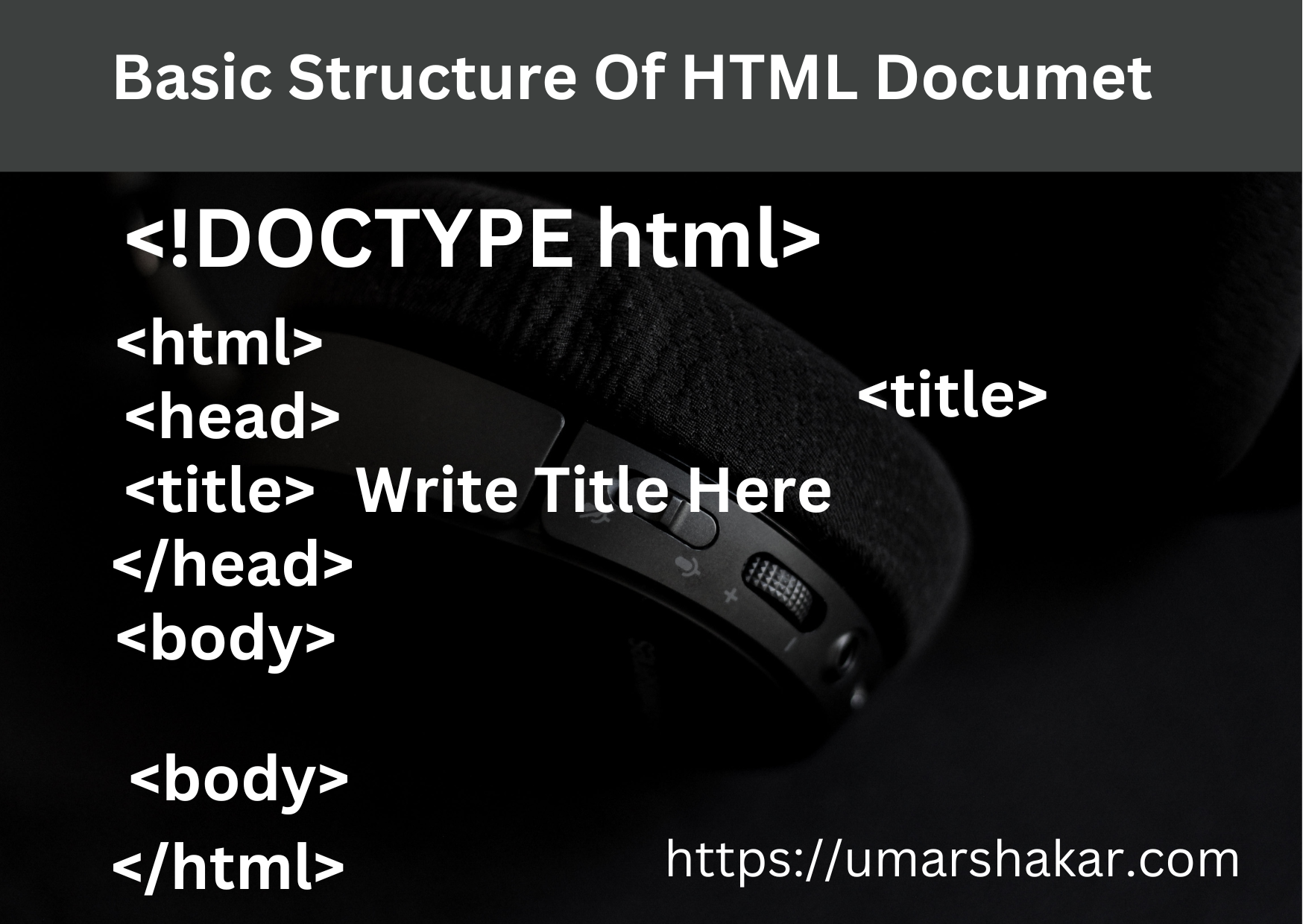
Basic Structure Of HTML Document Umar Shakar SEO Digital marketing Web Development


Explanation Of Above Example

  • The <!DOCTYPE html> declaration defines that this document is an HTML5 document
  • The <html> element is the root element of an HTML page
  • The <head> element contains meta information about the HTML page
  • The <title> element specifies a title for the HTML page (which is shown in the browser’s title bar or in the page’s tab)
  • The <body> element defines the document’s body, and is a container for all the visible contents, such as headings, paragraphs, images, hyperlinks, tables, lists, etc.
  • The <h1> element defines a large heading
  • The <p> element defines a paragraph

An HTML element is defined by a start tag, some content, and an end tag:

<tagname> Content goes here… </tagname>
The HTML element is everything from the start tag to the end tag:

<h1>My First Heading</h1>
<p>My first paragraph.</p>

HTML Tutorial - HTML Tag Explanation - Umar Shakar


SEO (Search Engine Optimization) – Get SEO Service

SEO: The Key to Online Visibility

Introduction

In today’s digital world, having a strong online presence is essential for businesses. But how can you ensure that your website is seen by the right people? The answer lies in Search Engine Optimization (SEO). SEO is a set of practices that optimize your website to rank higher in search engine results pages (SERPs) and drive more organic traffic. Let’s dive into understanding and mastering SEO for success.

What is SEO and Why Does It Matter?

Definition: SEO is the process of making changes to your website’s design and content to improve its ranking in search results from engines like Google, Bing, and others.
Importance: Search engines drive the majority of online traffic. Higher rankings in search results mean more visibility, leading to:

  • Increased website traffic
  • Improved brand awareness
  • Higher leads and conversions
  • Enhanced credibility and trust

How Search Engines Work

To understand SEO, we need to grasp how search engines operate. Here’s a simplified breakdown:
Crawling: Search engines deploy web crawlers (bots) to scour the internet and discover new web pages and content.
Indexing: Crawled pages are analyzed and indexed by the search engine, making them searchable.
Ranking: When a search query is entered, search engines use complex algorithms to rank the indexed pages, delivering the most relevant results to the user.

Key SEO Factors

SEO is a multifaceted discipline. Here are the major factors influencing your website’s search engine ranking:

Keyword Research

Finding and understanding relevant keywords people use to search for your products or services.
Tools: Google Keyword Planner, Ahrefs, SEMrush, etc. can help.
Image Suggestion 2: A person sitting at a desk using a keyword research tool. [Use a free image generation tool like DALL-E or Midjourney if you need a custom image]

On-Page SEO

Content Optimization: Using relevant keywords throughout your content (title tags, headers, meta descriptions, etc.).
Technical SEO: Ensuring your site is crawlable by search engines, with factors like site speed, mobile responsiveness, and clean code.
User Experience (UX): Providing a user-friendly website with easy navigation and valuable content.

Off-Page SEO

Link Building: Acquiring backlinks (links from other websites to yours) signals your site’s authority and trustworthiness.
Social Signals: Social media shares and engagement can positively influence your rankings.
Image Suggestion 4: A diagram illustrating the concept of link building with different sources linking to a website.

Local SEO

Optimizing your website for local searches, crucial for businesses with physical locations.
Tools: Google My Business is essential for local SEO.

Essential SEO Strategies

Here are practical SEO strategies to help you get started:

Your SEO Specialist Umar ShakarConduct thorough keyword research: Understand your target audience’s search terms.
Optimize your content: Use keywords seamlessly, provide valuable information, and use engaging headers.
Focus on technical SEO: Address any loading speed, mobile optimization, or structural issues.
Build high-quality backlinks: Reach out for backlinks from reputable websites in your industry.
Create shareable content: Promote your content on social media for potential backlinks and social signals.
Leverage local SEO tactics: Claim your Google My Business listing, optimize for “near me” searches.
Track your results and adapt: Regularly monitor your website’s analytics and adjust your strategy as needed.

Contact to get SEO Serivces